Well Water Filtration System for a Homestead: What to Test, Filter, and Avoid
 ">Discover Homesteading
Send an email
">Discover Homesteading
Send an email
Well Water Filtration System for a Homestead
The worst time to think about well water filtration is after the sink smells like rotten eggs, the shower turns orange, or a guest asks if the cloudy glass of water is “supposed to look like that.” On a homestead, water problems do not stay in the kitchen. They show up in livestock tanks, pressure pumps, water heaters, irrigation lines, coffee, laundry, and every jar you fill during canning season.
A good well water filtration system for a homestead starts with testing, not shopping. That sounds less exciting than ordering a shiny three-stage filter, but it is the difference between solving the real problem and building an expensive wall of equipment that misses the thing actually in your water.
This guide walks through what to test, which filters match common well issues, where to install them, and what mistakes to avoid before you spend money.
Start With Testing, Not a Filter Kit
Private wells are different from city water. There is no utility company treating and monitoring the water before it reaches your faucet. The well owner is responsible for testing, treatment, maintenance, and repairs. That is a big responsibility, but it also gives you control.
The EPA explains that private drinking water wells are not regulated under the federal Safe Drinking Water Act the way public water systems are, and more than 23 million U.S. households rely on private wells. Their private well guidance is a good first stop for understanding that responsibility.
At minimum, test a private well annually for bacteria, nitrates, pH, total dissolved solids, and other local concerns. Test again after flooding, nearby construction, a new well pump, a change in taste or odor, or a period when the well sat unused.
What to test first
- Total coliform and E. coli for bacterial contamination.
- Nitrates, especially near farms, septic systems, or livestock areas.
- pH, hardness, iron, manganese, and total dissolved solids.
- Arsenic, uranium, radon, or PFAS if they are known local risks.
- Hydrogen sulfide if the water smells like sulfur.
Do not rely only on a free test from a filter salesperson. Those can be useful for hardness or iron, but drinking water decisions should start with a certified lab or local health department recommendation.
If you are still designing the source side of your property, pair this with our off-grid water systems guide. Filtration only works well when the well, pump, pressure tank, and storage plan make sense together.
Common Well Water Problems and What Fixes Them
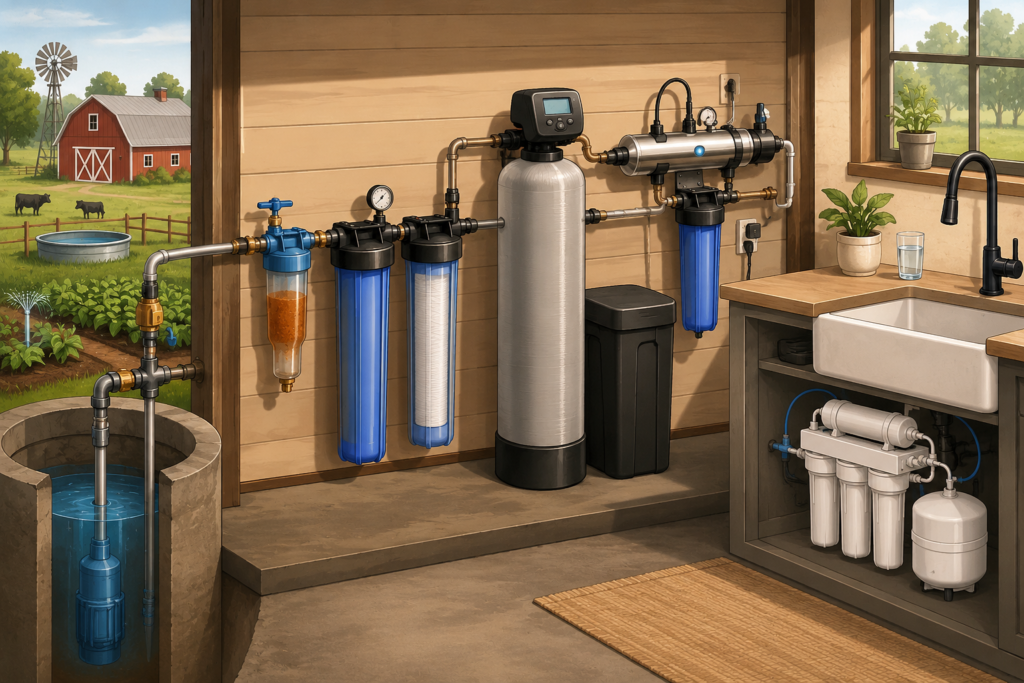
Well water problems usually fall into three groups: sediment, minerals, and microbes. Each needs a different fix. One filter cannot do everything, no matter how many promises are printed on the box.
Sediment and grit
Sand, silt, and rust flakes are common on rural wells, especially older systems or wells with disturbed water levels. Start with a spin-down filter or sediment cartridge before more delicate equipment. This protects pressure switches, appliances, UV systems, and carbon filters.
Use staged filtration when water is dirty: a coarse filter first, then a finer cartridge. If the first filter clogs every few days, you may have a well construction, pump placement, or pressure tank issue instead of a filter problem.
Hard water
Hard water is high in calcium and magnesium. It leaves scale on fixtures, reduces water heater efficiency, and makes soap feel stubborn. A water softener is the standard fix, but it adds salt management and maintenance. For a homestead, the question is not just “soft or hard.” It is where soft water belongs.
Many people soften household water but leave outdoor hydrants, gardens, and livestock lines untreated. That saves salt and avoids putting softened water where it is not needed.
Iron, manganese, and sulfur odor
Iron can stain sinks and laundry orange. Manganese may leave dark stains. Sulfur odor usually points to hydrogen sulfide or bacteria in the system. These problems may need oxidation, air injection, catalytic carbon, greensand, chlorination, or a combination system.
This is where testing matters. A carbon filter might reduce some odor, but it will not fix every sulfur or iron problem. If bacteria are involved, the well may need shock chlorination and follow-up testing before you install permanent treatment.
Where UV, Carbon, and Reverse Osmosis Fit
Different treatment tools belong in different places. If you install them in the wrong order, they work poorly or fail early.
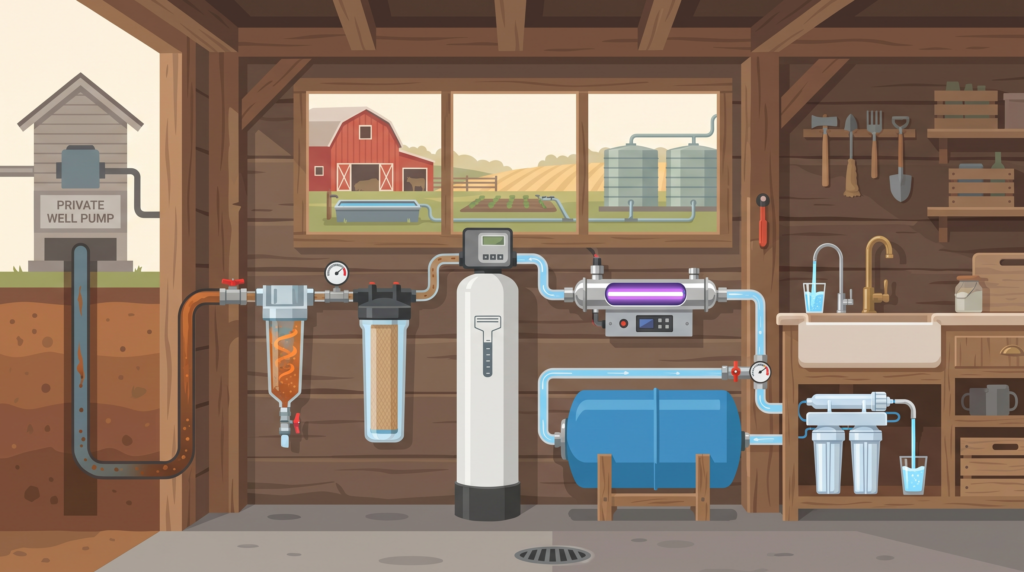
UV disinfection can be excellent for bacteria, but only after sediment is removed. UV light cannot disinfect what it cannot reach. Cloudy water, iron, hardness scale, or dirty sleeves can block the dose. The CDC’s well water treatment guidance emphasizes testing to identify the problem, treating it, and then testing again to confirm the treatment worked.
Activated carbon is useful for taste, odor, chlorine, and some organic chemicals, depending on the media. It is not a universal safety filter. It also needs replacement on schedule, because old carbon can become a problem instead of a solution.
Reverse osmosis is usually installed at one drinking water tap, not the whole house. It can reduce many dissolved contaminants, but it wastes some water and produces slower flow. For a homestead kitchen, an under-sink RO system can make sense for drinking, cooking, coffee, and baby formula while the rest of the house uses simpler treatment.
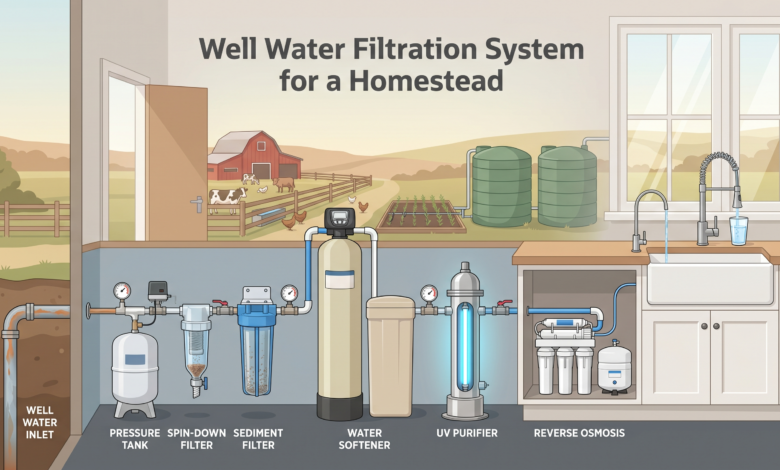
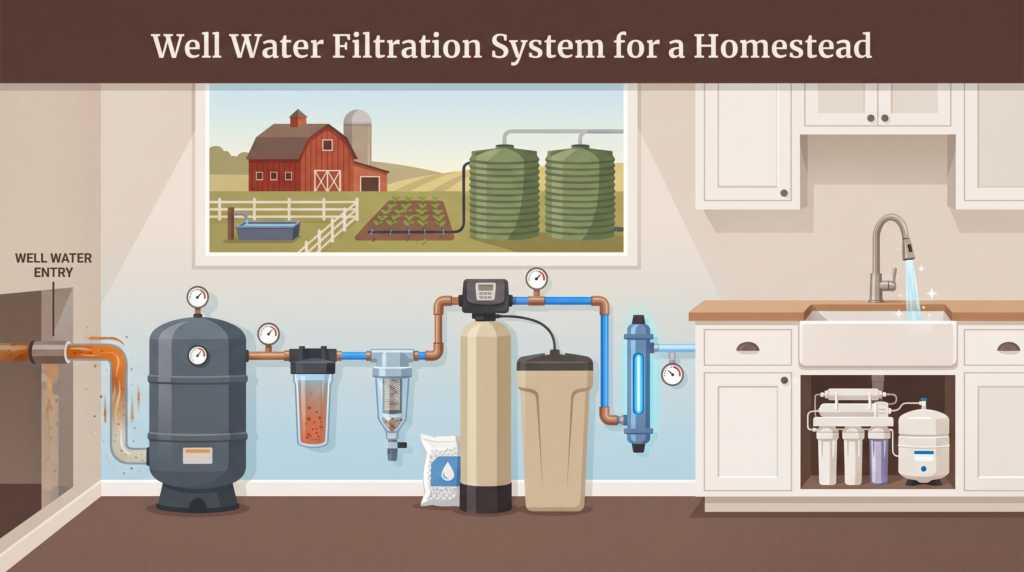
A practical filter order
- Well pump and pressure tank.
- Spin-down or coarse sediment filter.
- Iron, sulfur, or softening system if testing calls for it.
- Fine sediment filter before UV.
- UV disinfection if bacteria risk exists.
- Carbon or RO at the kitchen tap for taste and final polishing.
Your exact order depends on the water test. The goal is to protect each step from the problems upstream.
Homestead-Specific Design Tips
A homestead water system has harder days than a suburban house. It may serve a kitchen, bathroom, garden wash station, barn hydrant, livestock area, greenhouse, and canning setup. Treating every gallon to drinking-water polish is often wasteful.
Split the system when it makes sense. Potable household water may need sediment filtration, treatment, UV, and drinking water polishing. Irrigation and livestock water may only need sediment protection unless a test shows a safety concern. A barn hydrant used for buckets does not need the same setup as the kitchen sink.
Leave room around every filter. You will need to change cartridges, drain housings, replace UV bulbs, clean sleeves, add salt, bypass equipment, and read pressure gauges. A filter system wedged behind a stack of feed bags will be neglected. Neglected water equipment always collects its payment later.
For off-grid properties, power matters too. UV lights, well pumps, booster pumps, and treatment controllers all add load. If your system uses solar, compare this plan with our off-grid solar system setup guide so water treatment does not quietly overload the electrical system.
Keep a small maintenance log near the equipment. Write down cartridge changes, UV bulb dates, salt refills, pressure readings, water test dates, and odd symptoms. That notebook is boring until something changes. Then it becomes the fastest way to see whether the problem started after a storm, a pump repair, a new filter, or a long dry spell.
Common Mistakes to Avoid
The first mistake is buying a filter because of a symptom. Orange stains suggest iron, but the form of iron matters. Rotten egg smell may come from the well, the water heater, or bacteria in plumbing. Cloudy water may be air, sediment, or something that needs lab attention.
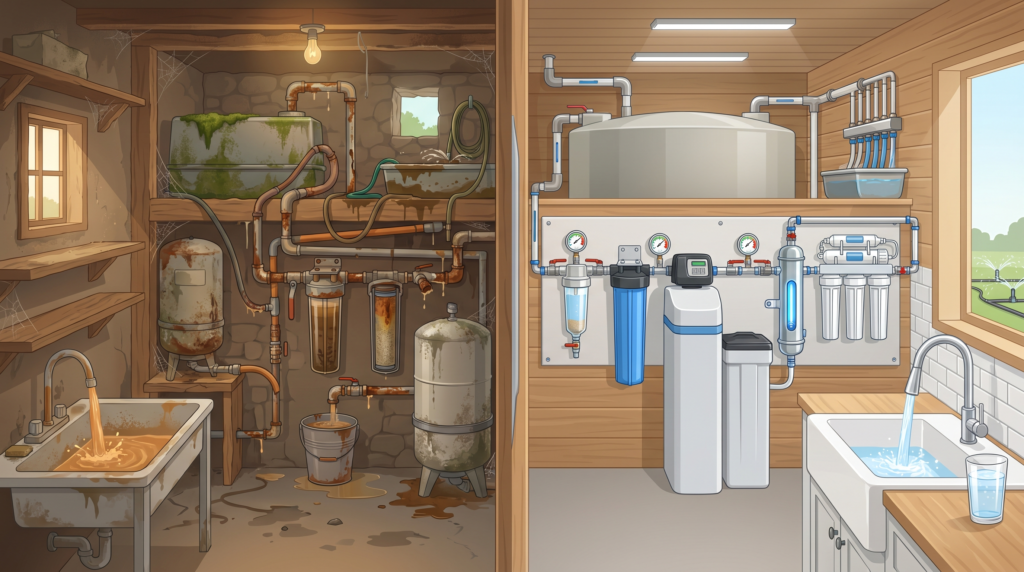
The second mistake is skipping retesting. A treatment system is not proven until the water is tested after installation. This matters most for bacteria, nitrates, arsenic, and any contaminant with health consequences.
The third mistake is ignoring flow rate. A filter that works at 4 gallons per minute may not work properly when two showers, a washing machine, and a hydrant are running. Undersized equipment can reduce pressure and tempt people to bypass the system.
Watch for these problems too:
- No pressure gauges before and after filters.
- No bypass valves for maintenance.
- Filters installed where freezing is possible.
- UV systems installed before sediment removal.
- Old cartridges left in place because they still “look fine.”
Conclusion
The best well water filtration system for a homestead is not the most complicated one. It is the one built around your test results, flow rate, household needs, and maintenance habits. Start with a real water test. Match treatment to the problem. Protect equipment in the right order. Retest after changes.
Clean water is not a luxury project on a homestead. It is the foundation under every meal, every animal chore, every jar of food, and every quiet morning when the faucet simply works.
FAQ
What is the best filter for homestead well water?
There is no single best filter. The right system depends on test results. Most homesteads start with sediment filtration, then add softening, iron treatment, UV, carbon, or reverse osmosis only when the water test calls for it.
How often should well water be tested?
Most private wells should be tested at least once a year for bacteria and common chemistry. Test sooner after flooding, repairs, a new smell, a change in taste, or long periods without use.
Do I need UV treatment on a private well?
UV can be useful if bacteria are a risk, but it must be installed after sediment and mineral problems are controlled. Always test before and after treatment.
Should livestock water be filtered?
Livestock water usually needs sediment protection and safety testing, but it may not need the same polishing as drinking water. If contaminants are present, ask a local extension office or veterinarian for animal-specific guidance.
Can I install a well filter system myself?
Simple sediment filters may be DIY-friendly. Bacteria, arsenic, nitrates, sulfur, pressure problems, and complex treatment systems are better handled with lab results and professional guidance.
">Discover Homesteading
Send an email